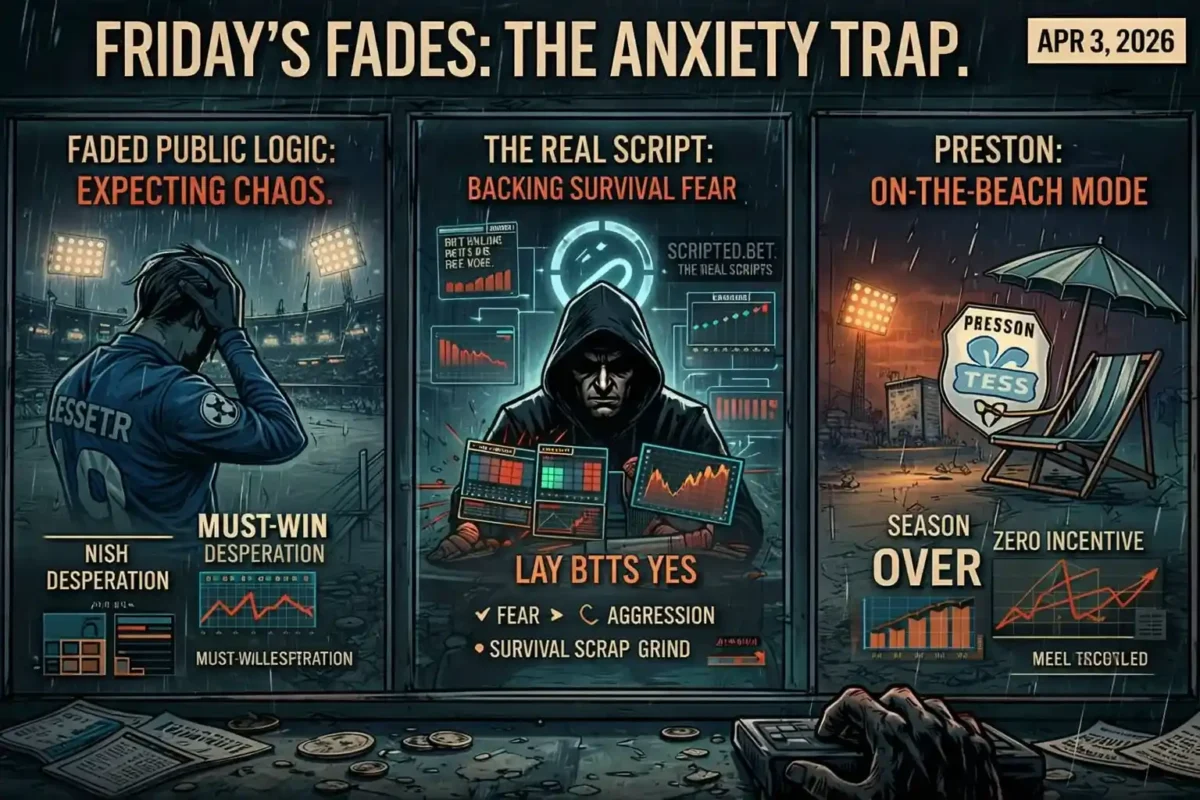

Intro
Welcome to the Friday slate.
After a clean sweep in Thursday’s international games, the market resets — and the public chases goals.
When casual bettors see a relegation battle, they immediately assume chaos. Desperation equals attacking football. Goals must follow.
But late-season survival football doesn’t create chaos.
It creates fear.
Tonight, we are stepping in front of that misconception, fading inflated goal expectations, and backing the suffocating psychology of an April relegation scrap.
Let’s step inside the Real Script.
Overview
Leicester vs Preston highlights a common late-season betting inefficiency where desperation is misinterpreted as attacking intent. In reality, relegation-threatened teams often become risk-averse, reducing game tempo and scoring probability. Markets frequently overprice goals in these scenarios.
The Slate
- Leicester vs Preston (Championship)
Leicester vs Preston
The Villain’s Move: Lay BTTS Yes
Risk: 0.97 Units to win 1.00 Unit
The Public Logic
The public sees a team fighting for survival at home.
Leicester must attack. They need points. Sitting back is not an option.
That naturally creates space for Preston to counter — and with Leicester’s high BTTS rate across the season, the conclusion feels obvious: both teams score.
Preston’s away profile reinforces the narrative. They rarely collapse, often find a goal, and play in open matches.
This looks like a textbook BTTS spot.
The Real Script
The market is projecting urgency.
The pitch will reflect anxiety.
Relegation pressure does not produce fluid attacking football — it produces hesitation.
Every pass becomes cautious. Every forward run is calculated. Every mistake carries massive consequences.
Leicester’s recent 0-0 against Watford is not an anomaly — it is a blueprint.
They are not opening up.
They are tightening.
Meanwhile, Preston arrive with no real objective.
Mid-table safety has already been secured, and their recent form reflects it — four losses in five matches, including poor performances away from home.
There is no incentive to force tempo, take risks, or engage in a high-variance game.
This creates a very specific match environment:
- One team is terrified to make mistakes
- One team with no reason to take initiative
- A slow, fragmented tempo
These games don’t explode.
They suffocate.
The BTTS Yes market is priced on season-long trends.
This match will be decided by psychology.
Why This Is a Classic Late-Season Trap
April football introduces unique market distortions.
- Desperation is mistaken for aggression
- Season-long metrics are overvalued
- Motivation gaps are ignored
These factors consistently inflate goal markets in survival scenarios.
Slate Summary
| Matchup | The Villain’s Move | Risk | Potential Win |
|---|---|---|---|
| Leicester vs Preston | Lay BTTS Yes | 0.97 Units | 1.00 Unit |
Final Totals
Total Risk: 0.97 Units
Total Potential Profit: 1.00 Unit
Closing Thought
The public bets urgency.
Sharp bettors understand fear.
And in relegation football, fear controls everything.
Frequently Asked Questions
Do relegation battles lead to high-scoring matches?
Not necessarily. While the public often expects open, attacking football, relegation battles typically produce cautious, risk-averse performances. Teams prioritize avoiding mistakes over creating chances, which often results in low-scoring matches.
Why is BTTS often overvalued in late-season games?
Betting markets often rely on season-long statistics, such as BTTS rates. However, these metrics fail to account for late-season psychological shifts, where pressure and fear reduce attacking intent and slow the tempo of matches.
Does motivation always increase attacking play?
No. Motivation in survival scenarios often leads to defensive discipline rather than attacking aggression. Teams become more conservative to avoid costly errors.
How does mid-table positioning affect a team’s performance?
Teams with no clear objective — such as those safe from relegation and out of promotion contention — often experience a drop in intensity. This can lead to slower games with fewer chances and lower overall competitiveness.
What is the best way to approach betting in relegation matches?
It’s important to focus on psychology and game state rather than season averages. Matches driven by survival pressure often favor unders, low-tempo play, and narrow scorelines rather than open, high-scoring games.








Leave a Comment