
Intro
Welcome to the Thursday slate.
International breaks create some of the most inefficient betting markets of the entire calendar year.
The public leans heavily on outdated information — group-stage tables from months ago, historical head-to-head records, and misleading “home vs away” designations that don’t reflect reality.
Tonight, we are attacking a classic market overreaction.
A historically capable side has been completely written off after a disastrous qualifying campaign, while their opponent is being inflated based on narrative comfort rather than situational truth.
We are stepping in front of the emotional money, buying at the absolute market floor, and playing the chaos of single-elimination football.
Let’s step inside the Real Script.
AI Overview
Ukraine vs Sweden presents a classic example of international football inefficiency, where outdated group-stage performance and nominal home advantage are overvalued. Neutral venues and knockout dynamics significantly increase variance, making underdogs with elite individual talent more dangerous than the market suggests.
The Slate
- Ukraine vs Sweden (World Cup Qualification Playoff)
Ukraine vs Sweden
The Villain’s Move: Lay Ukraine DNB / Play Sweden DNB
Risk: 3.20 Units to win 2.00 Units
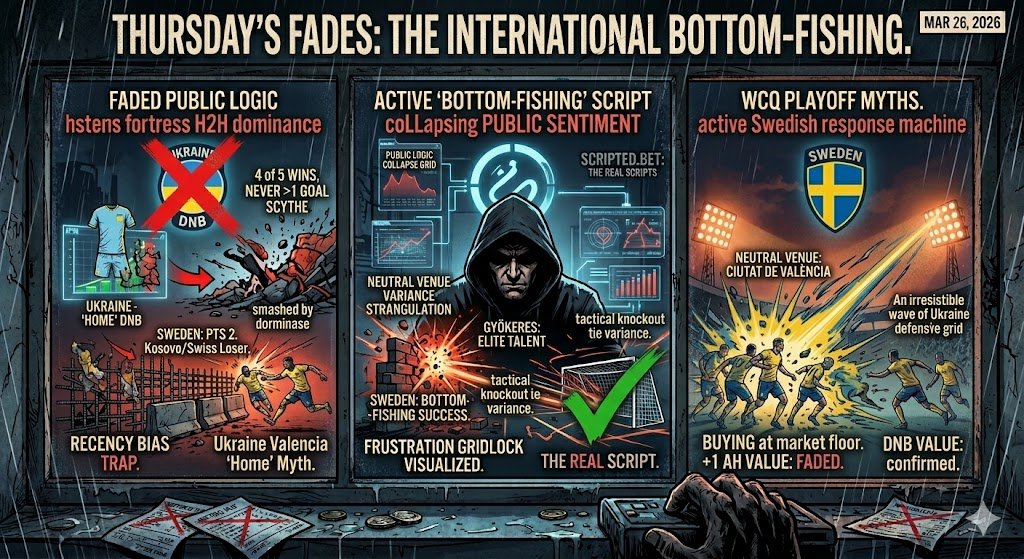
The Public Logic
The public sees two major signals.
First, Ukraine has dominated in recent head-to-head meetings, winning four of the last five encounters.
Second, Sweden’s disastrous qualifying campaign, collecting just two points from six matches, including losses to significantly lower-ranked opposition.
Combine that with Ukraine being listed as the “home” team, and the conclusion feels obvious: Ukraine should control this matchup.
The Real Script
The market is pricing past results. This match will be decided by the present conditions.
This is not a true home fixture.
Playing in Valencia removes the hostile, high-pressure environment typically associated with Eastern European venues.
The psychological edge of “home advantage” is significantly diluted. More importantly, this is a single-elimination playoff. These matches are defined by volatility, not consistency.
Sweden’s catastrophic group-stage performance has completely crushed their market perception, but it has not erased their underlying quality. They still possess elite, game-breaking players capable of deciding tight matches in a single moment.
In knockout football, one transition, one set piece, or one individual action is often enough.
Meanwhile, Ukraine’s perceived stability is being overvalued. They are not facing a structured, long-term campaign; they are entering a coin-flip scenario where variance dominates.
This is exactly where mispriced teams create value.
The Draw No Bet position allows us to exploit that mispricing while protecting against the volatility inherent to knockout football.
The public sees a broken team.
The sharper angle sees a market at its lowest possible valuation.
Why This Is a Classic International Trap
International playoff matches are frequently mispriced due to narrative bias.
- Group-stage results are overweighted
- Neutral venues distort home advantage
- Knockout variance increases unpredictability
These factors create opportunities where market perception diverges from reality.
Slate Summary
| Matchup | The Villain’s Move | Risk | Potential Win |
|---|---|---|---|
| Ukraine vs Sweden | Lay Ukraine DNB / Play Sweden DNB | 3.20 Units | 2.00 Units |
Final Totals
Total Risk: 3.20 Units
Total Potential Profit: 2.00 Units
Closing Thought
The public bets on recent results.
Sharp bettors bet on price and context.
And in knockout football, context is everything.
Frequently Asked Questions
Why are international playoff matches unpredictable?
Single-elimination formats increase variance, meaning one moment or mistake can decide the entire match regardless of overall team quality.
Does home advantage matter at neutral venues?
Not significantly. Neutral venues remove much of the crowd pressure and familiarity that typically give home teams an advantage.
Why can underperforming teams still offer value?
Markets often overreact to recent poor results, creating opportunities when underlying team quality remains higher than perceived.








Leave a Comment